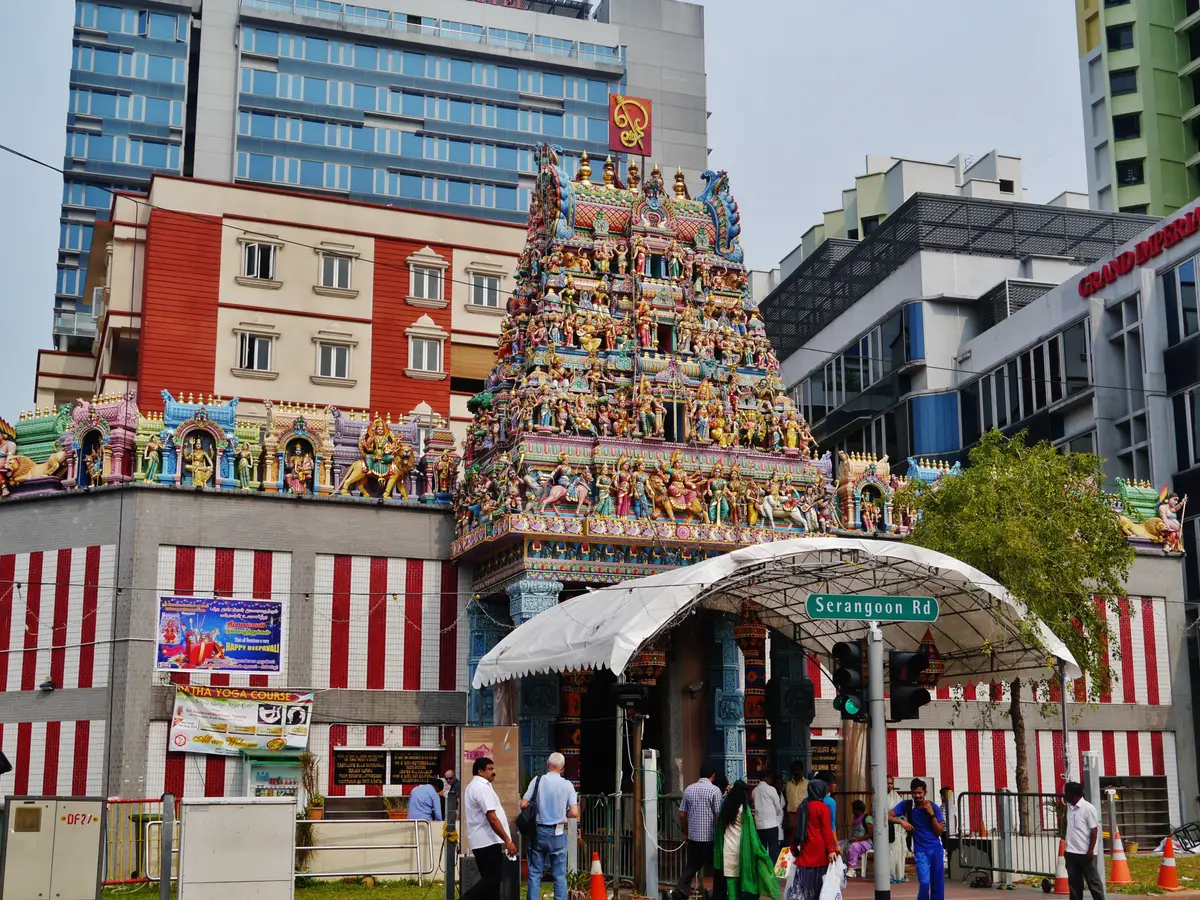
A quarter that began with cattle pens, now the loudest and most colourful streets in the city.
The least staged of the three heritage quarters, with an 1881 Kali temple and a 1900 villa, twenty minutes from the Civic District by train.
- Time needed
- About 1.5 hr
- Opening hours
- Streets always open. The temples keep their own hours, usually with a morning and an evening opening and a closed middle of the day; Tekka Centre's market trades early.
- Admission
- Streets and temples free; donations accepted.
- From the Singapore cruise port
- about 5 kmStraight line; the road is longer.
At a glance
- Grew out of a cattle trade: Europeans dealt in livestock along the Serangoon River and Indian workers took the jobs
- Gazetted a conservation area on 7 July 1989
- Sri Veeramakaliamman Temple began as a shrine to Kali and Parvati in 1855; Bengali labourers built the temple in 1881
- Sri Srinivasa Perumal Temple on Serangoon Road, from which the Thaipusam procession sets out
- The House of Tan Teng Niah, built in 1900, the last surviving Chinese villa in the district, restored in the 1980s
- Tekka Centre, the wet market and hawker centre at the Serangoon Road end
- Known among Indian Singaporeans simply as Tekka; the name Little India was promoted by the tourist board in the 1980s
About Little India
Little India did not begin as an Indian quarter. It began with cattle. Europeans traded livestock along the Serangoon River, which suited the business, and Indian migrant workers — Tamil Muslims, the Chulias, were among the earliest traders to arrive — took the work of rearing and handling the animals. When the swamps were drained the European farmers and dealers left, and the workers stayed. The district that grew out of that is the one you walk through now. It was gazetted a conservation area on 7 July 1989, and conservation was extended over the following decades along Desker Road, Syed Alwi Road and Jalan Besar. Indian Singaporeans mostly call the place Tekka; the name Little India was pushed by the tourist board in the 1980s.
The building to make for is Sri Veeramakaliamman Temple at 141 Serangoon Road. It began in 1855 as a shrine to Kali and Parvati, and the temple itself was built in 1881 by Bengali labourers. It was earlier known as Soonambu Kambam Kovil, the lime-village temple, after the lime kilns that worked nearby. It is a South Indian Tamil temple in form, and it is dedicated to Kali — fierce, not gentle, and the atmosphere inside is quite unlike that of a temple to a calmer deity. Further up Serangoon Road is Sri Srinivasa Perumal Temple, which is where the Thaipusam procession begins each year.
The other thing to find is small and easy to walk past: the House of Tan Teng Niah, on Kerbau Road just off Serangoon Road. A Chinese businessman, Tan Teng Niah, built it in 1900 — it is said, for his wife — and it is the last Chinese villa left in the district, with eight rooms, a five-foot way, a half-height pintu pagar door and a gilded nameplate reading Siew Song above the entrance. It was restored in the 1980s, and it is now painted in flat blocks of colour that have made it the most photographed house in Singapore. The colours are modern; the house is not.
At the quarter's southern end stands Tekka Centre, a wet market and hawker centre in one building, and it is the part of the district that is least arranged for visitors and most worth seeing for that reason. During Deepavali the streets are strung with lights and the crowds are heavy.
Visiting Little India
Good to know
Places near Little India
 Kampong Glamabout 1 km
 National Museum of Singaporeabout 1 km
 Fort Canning Parkabout 1 kmCivic District and the Padangabout 2 km
Little India: common questions
How long do you need at Little India?
About 1.5 hr
What are the opening hours of Little India?
Streets always open. The temples keep their own hours, usually with a morning and an evening opening and a closed middle of the day; Tekka Centre's market trades early. The temples close parts of the compound during rites, and are extremely crowded at Deepavali and Thaipusam.
Is there an admission fee at Little India?
Streets and temples free; donations accepted.
How far is Little India from the Singapore cruise port?
It is about 5 km from the Singapore cruise port in a straight line. The road is longer, and the drive depends on traffic.
How much walking is there at Little India?
Flat, but the pavements are narrow, crowded and often taken up by goods. Serangoon Road is busy with traffic and awkward to cross away from the lights.
From people who went
Nobody has written here yet. If you go, leave a line — the next ship reads it.
This place has the writing but not the recording.