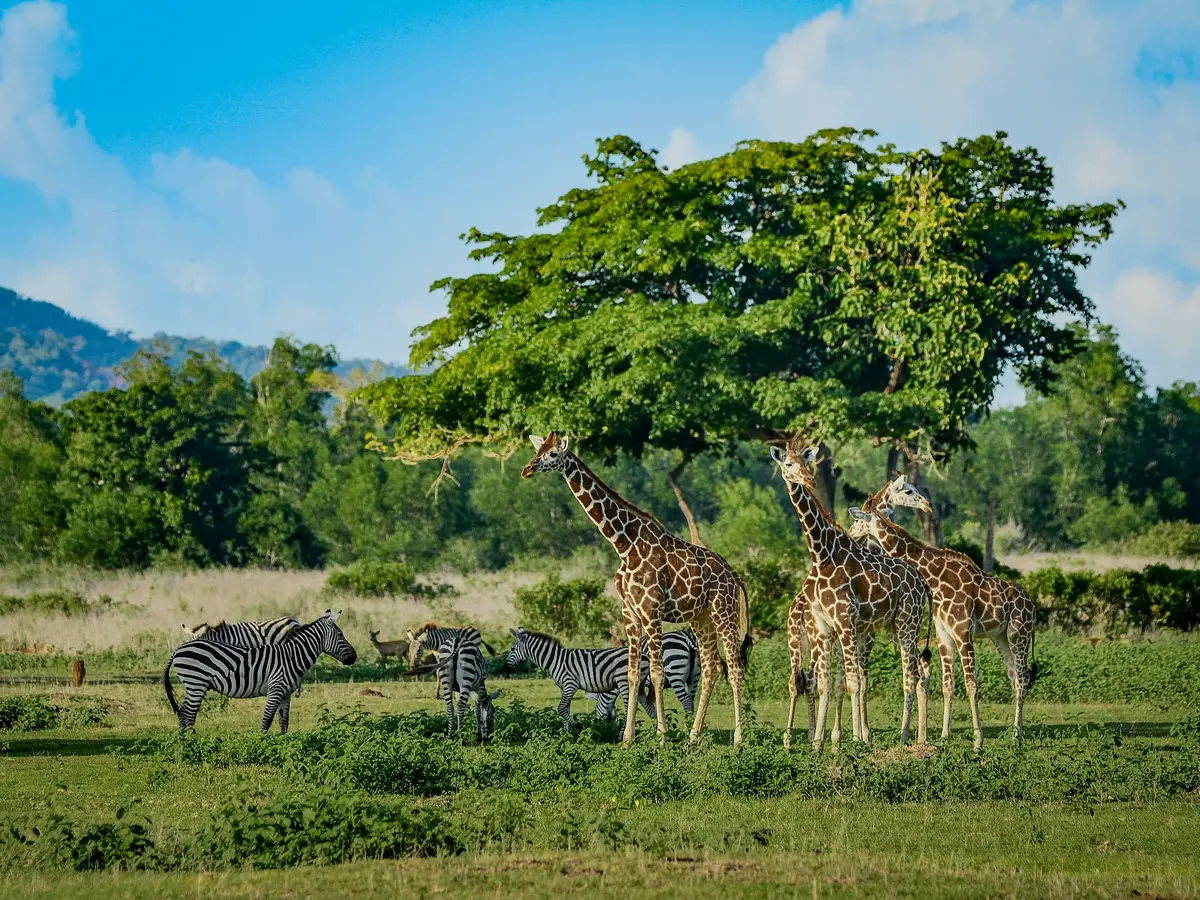
Giraffes and zebras on a Palawan island, and the history that put them there.
The excursion from Coron that is about history as much as scenery, and the one that takes a whole day. Long, hot, not a beach, and a boat crossing at each end of the road.
- Time needed
- A full day from Coron town
- Opening hours
- A full-day excursion sold from Coron town; the park is best in the early morning, when the animals are feeding, so tours start early.
- Admission
- A park admission is charged, and foreign visitors pay more than residents. Published figures are years old; ask on the day.
- From the Coron cruise port
- about 47 kmStraight line; the road is longer.
At a glance
- A wildlife sanctuary on Calauit Island, at the far north-west end of Busuanga — 3,400 hectares by the proclamation that created it, 3,700 in most later accounts
- Declared a game preserve by Presidential Proclamation No. 1578 on 31 August 1976, under Marcos
- 104 animals of eight African species were shipped from East Africa in 1976–77; reticulated giraffe and Grévy's zebra are the two that survive
- About 254 families, mostly Tagbanwa, were moved off the island before the park opened in 1977; a UN report described the eviction as made under duress
- On 3 March 2010 the National Commission on Indigenous Peoples titled Calauit Island and its surrounding waters to the Tagbanwa
- The Calamian deer, found only in these islands, was down to about 25 animals in the park when conservation work began in the 1980s and numbered 1,200–1,300 by 2016
- Run by the Provincial Government of Palawan since 2008
About Calauit Safari Park
There are giraffes on this island, and the story of how they got here is the reason to come. On 31 August 1976, Presidential Proclamation No. 1578 declared Calauit a game preserve and wildlife sanctuary over 3,400 hectares, "more or less" in its own words. Between May 1976 and August 1977, 104 animals of eight African species — giraffe, zebra, eland, impala, topi, waterbuck, bushbuck and gazelle — were shipped from East Africa and released here, on an island chosen because its climate resembled Kenya's. The official reason given was a Kenyan conservation request made through the IUCN. No record of such a request has been found at the IUCN.
Before the park opened in 1977, about 254 families, most of them Tagbanwa, were moved off the island to Halsey Island some forty kilometres away, a former leper colony with stony ground that would not farm. A United Nations report later described the eviction as made under duress; this was martial law, and there was no resisting it. On 3 March 2010 the National Commission on Indigenous Peoples titled Calauit Island and the waters around it to the Tagbanwa — the same body of law that holds Coron Island, about fifty kilometres south-east of here, for the Calamian Tagbanwa.
Six of the eight African species are gone: the impala, topi and bushbuck by 1999, the gazelle at about the same time, the eland and waterbuck by 2017. What is left is the reticulated giraffe and the Grévy's zebra, both still breeding and both tended with no full-time vet and a thin budget. The quieter success is native: the Calamian deer, which lives nowhere in the world but these islands, was declared critically endangered in 1981, and about 25 of them were left in the park when conservation work began in the 1980s. By 2016 there were 1,200 to 1,300, and the IUCN has since moved the species from critically endangered to endangered. The park has been run by the Provincial Government of Palawan since 2008.
Visiting Calauit Safari Park
Good to know
Places near Calauit Safari Park
 Mount Tapyas
 CYC Beach
Calauit Safari Park: common questions
How long do you need at Calauit Safari Park?
A full day from Coron town
What are the opening hours of Calauit Safari Park?
A full-day excursion sold from Coron town; the park is best in the early morning, when the animals are feeding, so tours start early. Weather on the crossing, and the road. Check with an operator in town rather than turning up.
Is there an admission fee at Calauit Safari Park?
A park admission is charged, and foreign visitors pay more than residents. Published figures are years old; ask on the day.
How far is Calauit Safari Park from the Coron cruise port?
It is about 47 km from the Coron cruise port in a straight line. The road is longer, and the drive depends on traffic.
How much walking is there at Calauit Safari Park?
Some walking on open ground and tracks, in the sun. The animals are approached on foot and by vehicle within the park.
From people who went
Nobody has written here yet. If you go, leave a line — the next ship reads it.
This place has the writing but not the recording.